Saturday, 2 July 2016

[REVIEW] ASUS ROG G752VY: The RockSolid Beast !


Gaming laptops come in all shapes and sizes these days. The ASUS ROG G752VY for example, looks like an absolute beast. In terms of both performance and design, the G752VY really brings its A-game. The laptop has an Armor Titanium and Plasma Copper colour scheme and a 17.3” display. Despite cutting an imposing figure, the G752VY is also a rather impractical choice if you’re one of those people who expect portability from a laptop, given that it weighs over 4kg.


Product Summary:


Asus ROG G752VY is a stylish and powerful gaming laptop that comes with a revolutionary design finished in a new Armor Titanium and Plasma Copper color scheme. It runs Windows 10 Home OS and is powered by latest 6th generation Intel Core i7 6820HK processor having a clock speed of 2.7 GHz coupled with 16GB DDR4 RAM at the speed of 2133 Mhz that is expandable upto 64GB. All the above features ensure that you breeze through all your tasks throughout the day. It is equipped with Nvidia GeForce GTX 980M dedicated GPU which delivers great gaming performance. Ample storage is available with 1 TB 7200rpm SATA hard drive and 512 GB SSD. It comes with a 17.3 inch Full HD Auto IPS LED Backlit Anti Glare Display with 1080 x 1920 pixels resolution, so the picture quality is crisp and detailed.

Asus ROG G752VY sports a HD webcam with dual digital microphone, 2 in 1 memory card reader and Blu ray DVD combo drive. A Touchpad with Multi-touch Gestures Support and Backlit anti-ghosting keyboard are available as input devices. Anti-ghosting keys ensure your commands are instantaneously and correctly interpreted, even if you hit up to 30 keys simultaneously. The connectivity options available are WiFi, Bluetooth v4.1, Four USB 3.0 slots, 1 x COMBO audio jack, 1 x USB 3.1 Type C Port, 1 x HDMI Port, 1 x Mini Display Port and 1 x Thunderbolt  Port.


Asus ROG G752VY is backed up by a powerful 8 cell 6000 mAh lithium ion battery and incorporates 2 speakers, Built in subwoofer and ASUS SonicMaster Technology that gives you immersive gaming audio. The device features the ROG-exclusive 3D mobile Vapor Chamber that together with the copper heat pipe creates an effective and efficient cooling system that helps improve GPU performance by up to 6 percent for smooth and stable gaming. It has a unique thermal design that directs dust into a dust-release tunnel to keep it away from internal components thereby prolonging component lifespan and enhancing overall stability of the laptop.

Verdict:


Thanks to it’s processor and graphics card, this beast is likely to last you around 3 years without any issue. Though if you do shell out more and get a desktop you’re likely to get better longevity due to better upgrade options. While the ROG G752VY is a breathtaking powerhouse, it would make for an practical choice for most average gamers. For the select few for whom it would make sense, it’s the perfect choice because this is a pretty good machine.

Author : Saatvik Awasthi

Wednesday, 6 April 2016

[REVIEW] Mi Bluetooth Speaker : The Wonderful little box


Bluetooth speakers of today are not just speakers that can pair with your smartphone wirelessly. A number of speakers we come across today are multifunctional devices, some of which come along with capabilities such as FM Radio, power bank and handsfree, along with being waterproof, dustproof, and the likes. In such times, seeing the sheer simplicity of the Mi Bluetooth Speaker really hits you.

The Mi Bluetooth Speaker’s straight lines in design, reasonably light weight, slim profile and the overall finesse of build gives the promise of being the ideal, inexpensive Bluetooth speaker to complement your weekend drive by the countryside. But does it? We find everything out after one week of listening to it. Here’s the detailed review of the Mi Bluetooth Speaker.


Build and Design

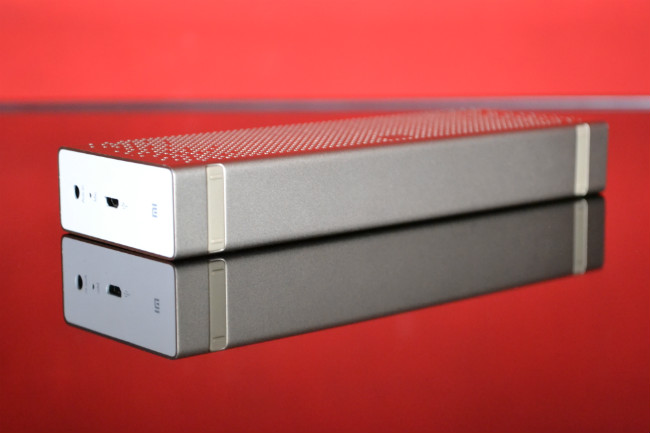
Over time, I’ve come to appreciate the sense of smoothness and simplicity that Xiaomi imparts to its products, and the Mi Bluetooth Speakers continue on Xiaomi’s usual design statement. The Gold shade (which actually would fall somewhere between Sand and Olive on the colour palate) has a muted shimmer on it, and the metal build feels confident. Plastic strips on either sides house the controls and ports for this speaker, while the front grille is built to please in terms of aesthetics. The bottom side of the speaker has two rubber strips with ridges to keep it in place on desks, and that’s it in terms of design


Overall, you get the sense that Xiaomi has kept every necessary element on the speaker, while leaving out any extravagance. This has led to a unique, simplified design statement about the Mi Bluetooth Speaker that I’m quite fond of. In terms of build quality, the metal used on the speaker is firm and smoothly done, not leaving any aberrations in terms of its finish. For the smooth metal finish, you do compromise on grip, something that the Logitech X50 excelled in. The plastic on either end of the speaker are sturdy, and do not feel flimsy.

The buttons, however, do not respond too well. The power/play button has poor feedback, and often gets dented upon pressing. While the volume buttons and the pairing/battery button fare much better, they are not the best around. The buttons reside to the right, while the microUSB and aux ports are placed to the left. The overall arrangement is neat and ergonomic, and completely uncluttered


The Mi Bluetooth Speaker gets everything right in terms of build, design and ergonomics, apart from button feedback and lack of grip. While the lack of grip can still be dealt with, seeing that Xiaomi intends you to place the speaker upright on desks or surfaces for most of the time. The speaker has a neat, affable signature that will keep it comfortable on suave, corporate desks. Neat job, Xiaomi.

Audio Performance


For the price, the Mi Bluetooth Speaker performs decently well. It is amply loud, and has a sense of warmth to its tone. The audio is reasonably well-balanced, although the mids are a little muddled. This leads to slightly unclear vocals in typically ‘heavy’ tracks, like Dream Theater’s Misunderstood. If you are a metal head, this may pose a problem. Alongside, the bass slightly overpowers the intricate riffs, and there is a slight amount of distortion on tracks at the highest volume level.

The Mi Bluetooth Speaker performs best when you play cleaner tracks, like the tracks from Cake’s Fashion Nugget album. The warmth adds to softening the highs, making tracks pleasant to listen to. The slightly heavy bass gives more definition to tracks here, and this leads to compactness in audio delivery that is really enjoyable. For the most part, at 80% volume, the Mi Bluetooth Speaker performs at its best. Switch to John Coltrane, and the audio sounds really good here. Even in Hip Hop and Funk, the audio delivery is quite pleasing for a speaker of this budget. However, the slight heaviness in bass frequencies will make you miss out on much of Flea’s bass intricacies. It preserves the overall sound, but do not expect it to give you all of what tracks hold.


The resultant of prominent highs and loud lows is slightly marred mids, but this does not really destroy the sound. In fact, for the most part, if you’re listening to Pop (The Corrs, for instance) or Post-Rock (Tool), you’ll be quite pleased with what you hear. Additionally, the loudness is ample and makes up for the limited soundstage that it offers. The audio delivery of the Mi Bluetooth Speaker is somewhat unidirectional and compact, not allowing a flourish of the audio setup. While many will enjoy the compactness of the audio, the lack of soundstage is particularly evident if you tune in to Hans Zimmer. The warmth and loudness do make up slightly for the restricted soundstaging, but it is noticeable, nonetheless. Having a metal body, the Mi Bluetooth Speaker vibrates to the beat of most tracks, which is a slightly jarring factor here. It affects the overall experience of listening by a slight margin.


The built-in speakerphone on the Mi Bluetooth Speaker means that you can receive calls and talk on the speaker without having to use your phone. Connectivity is provided by Bluetooth v4.0, and there is no actual drop in connection or call retention with the phone. Voice quality is firm and decent, and the loudness adds to its efficiency. Voice reception is reasonably decent, although I had to yell a little to make sure I’m heard on the other end, from a distance of about eight to 10 feet from the speaker.

Connectivity and Charging

Connectivity is smooth, swift and stable - you will not end up with sudden, unexpected drops in Bluetooth connectivity. If you do not play content on the speaker for about 10 minutes, it automatically disconnects from the phone to save on battery. In empty space, the Mi Bluetooth Speaker can remain connected to the source device till nearly 40 feet, while too many doors and chairs cut it down to about 30 feet, which is good enough. For the most part, if you’re hosting a house party and decide to play music on this from your phone, you will not need to worry about having to remain confined within your room to ensure continuous playback


The Mi Bluetooth Speaker charges from 0% to 100% in a little less than two hours, which seems somewhat slow. It lasts for around four hours and 30 minutes at the maximum, which is nearly as much as the Logitech X50. While this seems quite low, this is about as much as speakers in this price bracket last for.

Bottomline

The Mi Bluetooth Speaker looks suave, delivers clear, decent audio and has no connectivity issues, making for a very likeable, affordable wireless speaker that does not look out of place on suave, ebony work desks. Overall, at this price, the Mi Bluetooth Speaker makes for a very decent buy if you are looking for enjoyable music experience within your room. It will never hurt to spend more on audio, but the Mi Bluetooth Speaker is money well spent. Take our word for it.

Author : Anushk Keshri Rastogi

Source: Click Here

Saturday, 12 March 2016

[REVIEW] Xiaomi Redmi Note 3 : The Snapdragon Beast


Xiaomi Redmi Note 3 32GB: Detailed Review

The all-new Xiaomi Redmi Note 3 with the Qualcomm Snapdragon 650 SoC is almost a game-changer in terms of what one can expect from a smartphone priced at Rs. 11,999. It is a game-changer in terms of pure performance and battery-life, two key aspects of a smartphone that almost makes or breaks it for users in this price segment. After a relatively quiet period, Xiaomi has come back into the affordable smartphone segment with an impressive device that not only outperforms all smartphones in its segment, but also edges past some of the flagship Android smartphones. We have reviewed the 3GB/32GB variant of the Xiaomi Redmi Note 3, and there’s also a cheaper variant with 2GB/16GB configuration priced at Rs. 9,999.

Xiaomi Redmi Note 3 specifications:

 
SoC: Qualcomm Snapdragon 650 with hexa-core processor (2x1.8 GHz A72 + 4x1.4 GHz A53)
GPU: Adreno 510 GPU
RAM: 3GB LPDDR3
Storage: 32GB with microSD card slot for expansion via the SIM 2/Hybrid slot
Screen size and Resolution: 5.5-inch 1080p IPS display
Network Support: 4G LTE support, LTE support for Band 3,5,40 and 41 in India.
Dimensions: 150 x 76 x 8.65mm
Weight: 164g
Battery: 4050mAh
Fingerprint scanner
Rear Camera: 16MP, f/2.0 with phase detect AF and dual tone led flash
Front Camera: 5MP, f2.0 front camera
IR Blaster
Android Lollipop 5.1.1 running on MiUI 7

Performance under the Hood


The newly-launched Xiaomi Redmi Note 3 is all about performance, and most of it comes from the Snapdragon 650 SoC.  Such high performance usually comes at the cost of some sort of a trade-off in battery life or thermal management capability. But, in case of the Xiaomi Redmi Note 3, you can have it all (more on this later). Benchmark numbers aside, we decided to tax the smartphone with some of our own back-to-back tests that are known to bring most smartphones down on their knees. We started with recording a 5-min UHD (2160p) video clip, something that isn’t supported by the default camera app on the Xiaomi Redmi Note 3, but we bypassed the limitation via the Google camera app that records videos in UHD on this smartphone. The UHD video capture test was immediately followed by a 30-minute gaming session (Asphalt 8 + Modern Combat 5), and we ended the test with a quick re-run of the AnTuTu benchmark. Across all the three tests, the Xiaomi Redmi Note 3 showed no signs of stuttering or excessive heating. Apart from the benchmark numbers, the Xiaomi Redmi Note 3 offers truly excellent performance in real-world scenarios, and it does that without any compromises like heating issues or rapid battery drain. Talking about heating issues, unlike the Xiaomi Mi 4i, the Redmi Note 3 doesn’t get excessively warm or uncomfortable when put under stress. 


Battery : The fuel to power the Beast


Xiaomi’s “recipe” behind the Redmi Note 3 has a lot to do with the battery inside the device. The 4050mAh battery inside the device is big in capacity, but small in volume. Xiaomi has achieved this by packing a 690Wh/L high density battery inside the Redmi Note 3. In terms of real world usage, on a full charge, we were easily able to get through a full day of heavy usage with 15% of battery life left at the end of the day. For average usage patterns, you can expect two days of battery life from the Xiaomi Redmi Note 3. The graphs below show how the Xiaomi Redmi Note 3 compares to other devices in the battery life department. As far as charging is concerned, the Xiaomi Redmi Note 3 goes from 5% to 100% in little over 2 hours of charging time with the supplied charger.

Camera : 


The Note 3 Pro comes with an improved 16 MP, f/2.0 rear camera with phase detection autofocus, dual-LED (dual tone) flash and is capable of recording videos at 1080p@30fps. It retains the typical 5MP, f/2.0 front-facing camera.

The rear camera takes good pictures outdoors and in well-lit conditions, capturing great detail even when zoomed in. It can also take decent shots even in low-light conditions indoors. Auto-focus and shutter speed are fast. Camera app settings include the usual features for manual, panoramic, beautify, as well as a fish-eye feature. It also has cool filters such as “Mosaic” “Yesterday” and “Sketch”. You can navigate these features by swiping the screen left and right.

When using the front-facing camera, the camera app will detect your face, identify you as male or female, and guess your age. Creepy. Sometimes the camera guesses right or adds a few years to your actual age, depending on how tired you may look. It’s simply discouraging to be taking selfies only to be told by the camera you look older than you are. Best to disable this feature.

Design : Looks and feels Premium


The Redmi Note 3 represents a drastic change in design language for Xiaomi. No more less than premium plastic – the new phone now sports an all new brushed aluminum metal body that’s available in gold, silver and grey colors. It’s a great upgrade to the all-plastic Redmi Note 2 which was a literal smudge magnet. Xiaomi has also thrown in a fingerprint scanner on the back that facilitates easier and faster unlocking, similar to the offerings of Xiaomi’s domestic rivals, Huawei and OPPO. 

One thing that did annoy us though was the speaker placement. Unlike the designs of other companies, Xiaomi has placed the speaker grille at the back, which makes it a challenge to hear the phone when it’s ringing when it’s laying flat on the table, screen up.


The layout of the phone is more or less the same as its predecessor, with the 3.5mm audio jack on the top, the USB port is on the bottom (and has OTG capability) with the power and volume keys on the right. The dual sim cards are both LTE compatible for both Smart and Globe networks. Surprisingly enough, Redmi took away its expandable micro SD slot which is present in all Redmi series which came before this one, with the Redmi Note 3 falling more in line with the Mi 3i and other devices when it comes to microSD expansion capability.

The Redmi Note 3 sports a 5.5 inch, full HD IPS display that translates to around 403 ppi. Its colors are very vibrant and crisp and it doesn’t have a yellow tinge to the image. The 5-megapixel front facing camera is upgraded to 1080p and is also moved to the right side.


Putting it side by side with the iPhone 6s, it really looks similar on the edges and especially on the feel of the metal casing. This isn’t surprising considering that other Chinese manufacturers take liberal design language inspirations from the Cupertino company.

Bottomline

 
The Xiaomi Redmi Note 3 is a highly recommended smartphone in its price segment, especially if you are looking for a smartphone that offers unparalleled performance and battery-life. The only possible downside to the Xiaomi Redmi Note 3 is its weak low-light camera performance and the fact that it ships with Android Lollipop-based MiUI 7 rather than the expected Marshmallow-based MiUI.

  
Author : Anushk Keshri Rastogi

Friday, 19 February 2016

[REVIEW] Samsung 750 EVO SSD Review


Samsung decided to bring its low-cost SSD 750 EVO to the U.S. after shipping it for months in Asia. The drive employs planar (2D) three-bit per cell NAND like the 840 EVO, but sees its controller upgraded with low-density parity check (LDPC) error correction technology found on the 850 family. 

Samsung's 840 EVO arrived with great fanfare and generated a lot of excitement, becoming the best-selling SSD of all time. Over time though, a problem emerged. Customers found that older data on the drives would read back much slower than fresh data. Samsung fired back with a pair of firmware upgrades and we haven't heard much of the issue since then. 

Although it was never officially mentioned, we suspect the underlying issue had to do with the 840 EVO's error correction engine. Samsung recently told us that the 840 EVO used BCH ECC technology, similar to many other SSDs with MLC flash. Newer drives with TLC NAND employ a technology called LDPC (low-density parity-check), which is a much stronger form of error correction that uses both hardware and software checks to recover bit errors.

The new SSD 750 EVO uses the 850 EVO's controller equipped with the more advanced LDPC ECC engine. The SSD was introduced in Japan and other Asian markets two months ago. We assumed the 750 EVO was Samsung's way of burning through a stockpile of planar (2D) NAND before transitioning to 48-layer 3D flash. The company recently stated that planar flash still has a future, and will not disappear from its line-up anytime soon. Samsung's 2D NAND is manufactured using 16nm lithography, and we've heard rumors of a 14nm node in development. 

The 750 EVO also crams a 256MB DDR3 memory module in the same package as the MGX controller, which should reduce latency between the processor and its DRAM buffer. This is the first time we've seen the advanced design in a Samsung SSD.
  

Specifications


Products
Samsung 750 EVO
(250 GB)
Samsung 750 EVO
(120 GB)
Form Factor
2.5-inch.
2.5-inch.
Controller
Samsung MGX
Samsung MGX
DRAM Buffer
256 MB DDR3
256 MB DDR3
NAND
Samsung 16nm TLC
Samsung 16nm TLC
Sequential Read
540 MB/s
540 MB/s
Sequential Write
520 MB/s
520 MB/s
Random Read (QD1)
Up to 10,000 IOPS
Up to 10,000 IOPS
Random Read (QD32)
Up to 97,000 IOPS
Up to 94,000 IOPS
Random Write (QD1)
Up to 35,000 IOPS
Up to 35,000 IOPS
Random Write (QD32)
Up to 88,000 IOPS
Up to 88,000 IOPS
Interface/Protocol
SATA 6 GB/s / AHCI
SATA 6 GB/s / AHCI
Encryption
AES 256-bit FDE TCG/Opal v.2.0
Endurance
35 TBW
70 TBW
Warranty
3 Years
3 Years


The SSD 750 EVO only ships in two capacities: 120 and 250GB. Armed with a reworked MGX controller, 256MB of DDR3 and TLC flash, it fits in the SSD market's lowest-cost segment. At first we were thrown by the lack of visible DRAM, particularly since Samsung's controller package is similarly sized. Surely, though, the integrated buffer represents a step toward reducing costs. 

Samsung's SSD 750 EVO claims some impressive performance figures. Its sequential read performance peaks at 540 MB/s. Both capacities also peak at 520 MB/s sequential buffered writes. And once again, Samsung manages to squeeze out 10,000 random read IOPS with minimal parallelism. This is attributable to the quad-plane design that doubles the available bandwidth between the controller and flash. 

We're told that the 750 EVO targets system builders, and will allow integrators to add SSDs to low-cost notebooks and desktops. Its performance specifications are similar to the company's retail SSDs, but at much lower endurance levels. To compare, the 120GB 750 EVO is rated for 35 terabytes written. The same capacity 850 EVO sports a 75 TBW specification. The gap increases when you step up to 250GB (70 TBW versus 150 TBW).

You do get support for AES-256 full disk encryption, enabling TCG Opal v.2.0. The drives also work with Microsoft's BitLocker feature.

Pricing, Warranty And Accessories


The MSRP for the 120GB model is $54.99 and the 250GB capacity model is priced at $74.99. We expect to see more prevalent use of the SSDs among the tier-two system builders like Origin PC, CyberPower and AVA Direct. Most of those companies will handle warranty claims directly, but Samsung does back the drive with a three-year warranty capped at the TBW rating. 

The 750 EVO does support Samsung's Magician software. Moreover, this series supports the company's Rapid Mode technology, which utilizes DRAM as a read and write cache. Samsung's Data Migration Tool is compatible as well, though neither software package is included and will need to be downloaded.

According to Samsung, the 750 EVO will ship in a full retail box similar to the 850 EVO and 850 Pro models. At a glance, the 750 EVO looks like a standard 2.5-inch SSD with a slim 7mm z-height. This is the same chassis the company uses on other products like the 850 EVO.  


Inside, we find a very small PCB hosting a handful of components. The images show the 250GB model with flash on both sides of the board. Again, the missing DRAM caught us off guard. Samsung didn't talk about its integration efforts during our call a week ago. But by pulling the DDR3 onto the controller's package, latency between the two components should be reduced. Samsung isn't talking about DRAM clock rates or timings, though. The 120GB model loses the NAND package on the back of the PCB. This is a very low-cost design with low overhead.
 

Comparison Products

 Nearly all of the drives in our comparison charts utilize TLC NAND with write enhancement mechanisms to deliver high burst speeds that are not sustainable for more than a few seconds.

Samsung's SSD 850 EVO is the current mid-range performance leader. Its quad-plane TLC flash breaks the mold and delivers longer sustained write speeds than other TLC-based drives with flash from Toshiba and Micron. The Plextor M6V is a newer model that uses the same approach as the Reactor. It comes equipped with the same SMI SM2246EN controller, but pairs it with Toshiba's 15nm MLC NAND.

Sequential Read Performance


Even with eight levels of charge to sort through, nearly every drive hits the SATA interface's maximum performance level. As always, queue depth is important to consider, and we see more performance variation at the low queue depths encountered on a daily basis. 

Samsung's 750 EVO 250GB outperforms the 850 EVO, though the results indicate only a slight difference between both products. The 120GB 750 EVO does give up some sequential read speed at low queue depths compared to the other Samsung drives, but that's to be expected since it's working with half as many flash dies.

Sequential Write Performance


Samsung's TurboWrite algorithm performs well in our tests, even though we don't leave a lot of time for the buffer to flush between runs. Many competing products show up as waves, since they struggle to flush the emulated SLC buffer data to much slower TLC. 

Samsung's 750 EVO maintains writes in excess of 200 MB/s. Until recently, Samsung was the only vendor to hit that level using TLC NAND. Phison has caught up, though, with its direct-to-die write algorithm. We simply don't have a low-capacity Phison S10-based drive to add to our charts.  

The 120GB SSD 750 EVO reaches the same performance in the buffer stage, but writes quickly drop to 140 MB/s after an extended load. TLC's native write speed won't become an issue until you need to send a lot of data to the drive at one time. Installing software and transferring large photo albums are two common examples of when you'd do that. 

Conclusion 

Although there are corner cases where one SATA-based SSD outperforms another, even enthusiasts have a tough time telling the difference under light or moderate workloads. Increasingly, absolute performance is taking a backseat to price and, in many cases, reliability when we make our buying decisions. 

 At this year's CES, Samsung let us know that its 750 EVO SSD would become available worldwide. Up until then, it was only sold in a few select Asian markets. I was even hunting for a vendor to buy from in Japan.

When the 750 EVO was first announced, Samsung didn't delineate that the SSD's primary target was system integrators. Now that we understand the product better, we know why it was so difficult to purchase. The 750 EVO is also more affordable than the 850 EVO, competing with other ultra-lowcost drives. With a MSRP of $74.99 for the 250GB model and $54.99 for the 120GB version, the 750 EVO can compete with drives that the 850 EVO can't.
The 750 EVO's endurance rating pigeonholes the drive as an entry-level offering, despite deceptively good performance. This should not come as a surprise; it's typical of Samsung to target a segment with pricing, only to soak up market share with a product superior in other ways. 


 Like the 850 EVO, Samsung's 750 EVO introduces the performance of a higher-end SSD to a lower price point. The new drives even deliver 10,000 random read IOPS, so you can be sure your storage experience will be responsive. Who would have thought we'd be identifying an excellent-performing 250GB-class drive in the $70 price range so early in 2016?